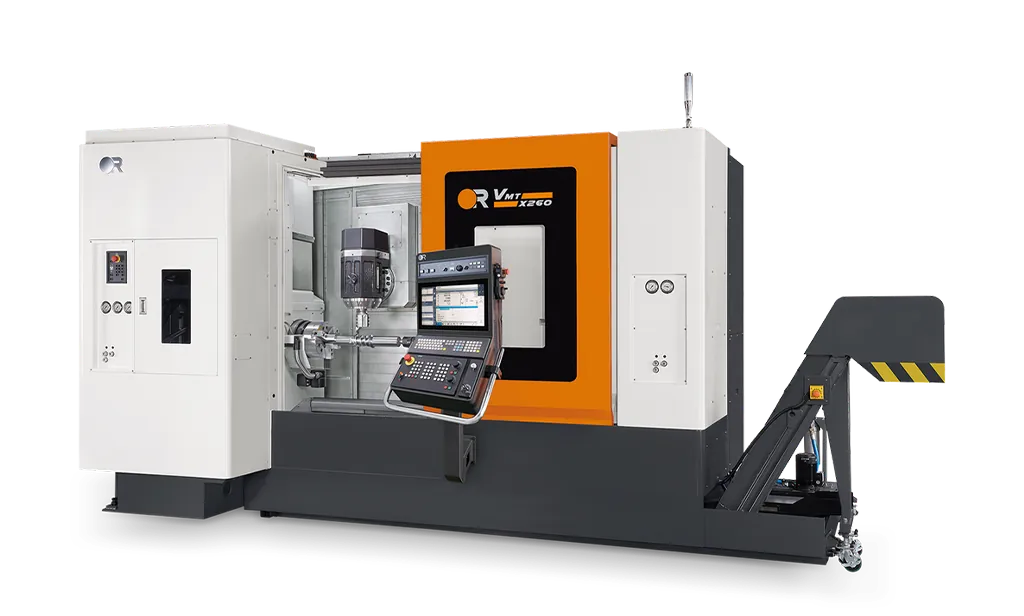
Many turned parts are not finished on the lathe. Flats, keyways, cross holes, tapped holes on a pitch circle and off-centre pockets all send the part on to a machining centre for a second operation, sometimes a third. A multi-tasking turning centre, such as the Victor VMT-X series, puts a milling spindle and a Y axis on the lathe so those features are cut in the same setup.
What changes when the part stays in one machine
- No second setup. There is no re-clamping, no new datum and no fixture to design, make and store.
- Better accuracy between features. Turned diameters and milled features come from the same clamping, so their relationship is held by the machine rather than by a fixture.
- Less work in progress. Parts do not queue between machines, which shortens lead time and frees floor space.
- Finished parts. With a second spindle, the part can be transferred and its back face machined, so it leaves the machine complete.
What it costs
A multi-tasking machine costs more than a plain lathe, and usually more than the simplest lathe-and-mill pair. Programming is more involved, because turning and milling operations have to be planned together, often with simulation to check for collisions. Its cycle time per part can also be longer than either machine alone, even though total time through the shop is shorter.
Questions that point the way
- How many of your turned parts go on to a second machine? If it is most of them, a multi-tasking machine removes a whole step from your process.
- How tight is the relationship between turned and milled features? If position errors between operations cause scrap or rework, one clamping solves the root cause.
- What batch sizes do you run? Small and medium batches of complex parts gain the most, because setup time is a large share of the job. Very long runs of simple parts may still be cheaper on dedicated machines.
- Do you need both ends finished? If so, look at twin-spindle versions.
Sizes in the Victor range
The VMT-X series runs from an 8 inch chuck on the VMT-X200 to a 15 inch chuck on the VMT-X400, with Y-axis travel of up to 420 mm on the larger models. The Vturn-Q200 takes a different approach, using more than one turret to cut faster on high-volume turned parts. Compare the key figures on the multi-tasking turning centres page.