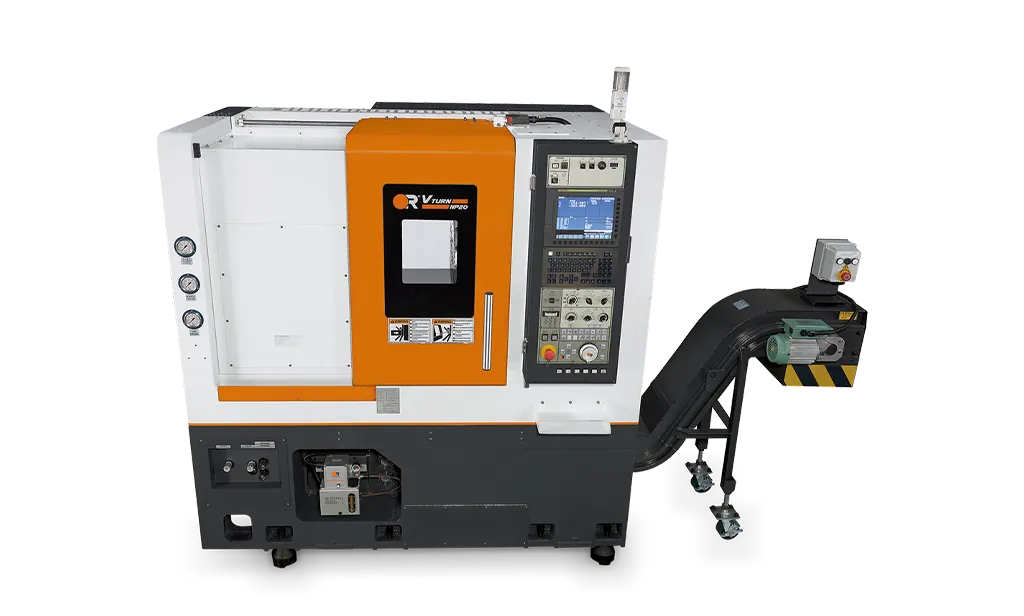
Every CNC lathe moves its turret and carriage along a set of guideways, and the type of guideway shapes how the machine behaves more than almost any other part of the design. The Victor Taichung range has both kinds: the Vturn-NP lathes run on linear guideways, while the Vturn-F, Vturn-S and large-swing lathes use box ways.
Neither is better in general. Each suits a different kind of work.
How the two designs work
Linear guideways are hardened rails with recirculating ball or roller blocks running along them. Contact is rolling rather than sliding, so friction is low and the axes can accelerate and stop quickly.
Box ways are wide, flat, hardened slideways machined into the bed. The saddle slides directly on them with a low-friction lining between the surfaces. Contact is spread over a large area, so vibration from the cut is damped by the mass and friction of the slide.
Where linear-way lathes shine
- Short cycle times. Fast rapids and quick axis reversals matter when a part takes seconds rather than minutes and the machine spends much of its time moving between cuts.
- Small and medium parts. Pins, bushes, fittings and short shafts in steel, aluminium and brass rarely need the extra damping of box ways.
- Finishing work. Low friction helps the axes make very small, smooth moves, which suits fine finishing passes.
The trade-off is damping. A linear-way machine can still take heavy cuts, but on hard, tough or interrupted cuts it is more likely to show chatter than a box-way machine of the same size.
Where box-way lathes shine
- Heavy roughing. Large depth-of-cut work in steel, cast iron and forgings benefits from the stiffness and damping of a wide slideway.
- Interrupted cuts. Castings with cored holes, flats or weld beads load and unload the tool on every revolution. Box ways absorb those shocks well.
- Long, heavy shafts. The large-swing Vturn lathes in the Victor range, with turning lengths of several metres, are box-way machines for this reason.
The trade-off is speed. Box-way axes cannot match the rapid traverse and acceleration of a linear-way machine, and the slideways need correct lubrication to keep friction low.
A simple way to decide
Look at the parts you make most often, not the hardest part you might one day quote for:
- If most jobs are small parts in batches, with cycle times under a few minutes, a linear-way lathe will usually produce more parts per shift.
- If most jobs involve heavy stock removal, tough materials or interrupted cuts, a box-way lathe will usually hold tool life and surface finish better.
- If the work is mixed, chuck size and turning length often decide it before the guideway type does. Compare the key figures for each model on the CNC lathes page.
Upkeep
Both designs last for many years if they are lubricated and kept clean. Linear guideways rely on their seals and the automatic lubrication system, so chip and coolant ingress is the main enemy. Box ways need their way-oil supply checked regularly and the wipers kept in good condition. Either way, a planned service schedule does far more for accuracy than the choice of guideway.