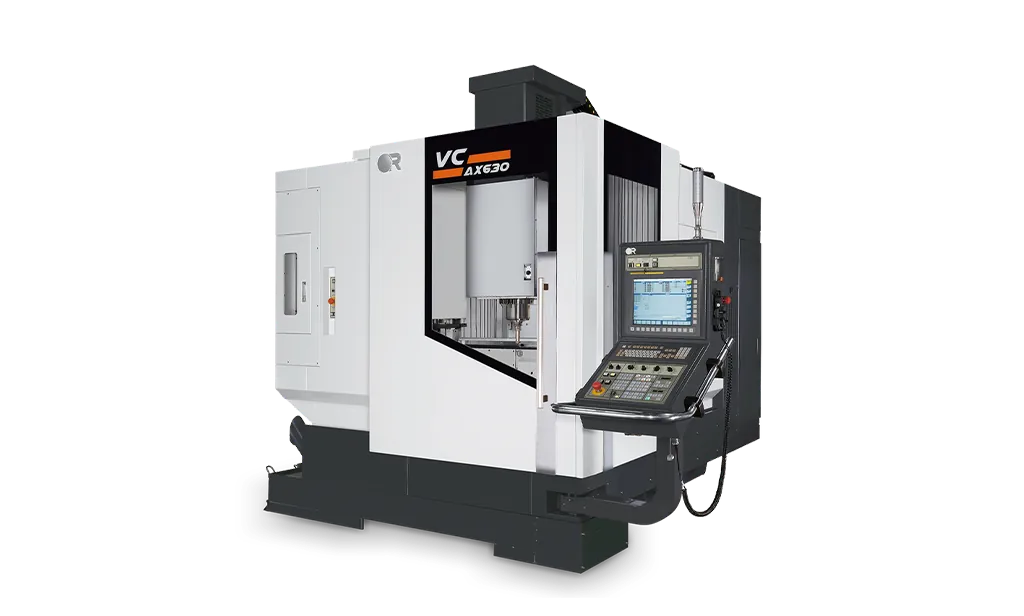
A 5-axis machining centre adds two rotary axes to the usual X, Y and Z. On table-type machines, the rotary axes tilt and turn the table so the spindle can reach the part from many directions. How you use those extra axes falls into two broad styles, and most shops use far more of one than the other.
3+2 positioning
In 3+2 work, also called positional or indexed 5-axis, the two rotary axes move the part to an angle and then lock. The machine then cuts with ordinary 3-axis moves. When that face is done, the rotary axes move to the next angle and lock again.
This is ideal for prismatic parts with features on several faces: housings, manifolds, brackets and valve bodies. It replaces a series of separate setups and fixtures with one clamping, which brings three benefits:
- Accuracy between faces. Every feature is cut from the same datum, so there is no stack-up from re-clamping.
- Less handling. One load and one unload instead of four or five.
- Shorter, stiffer tools. Tilting the part lets the tool reach deep features from a better angle, so it can stick out less.
Simultaneous 5-axis
In simultaneous work all five axes move together while the tool is cutting. The tool can follow a curved surface while staying at the best angle to it.
This is what shapes impellers, blisks, turbine blades, complex mould surfaces and many medical implants. Without simultaneous motion those surfaces would need ball-nosed tools taking very fine steps, or could not be reached at all.
Simultaneous work asks more of everything around the machine:
- CAM software capable of 5-axis toolpaths and collision checking.
- Programming skill, because tool orientation and machine limits have to be managed as well as the path.
- Machine dynamics, because the rotary axes must move smoothly at feed rather than just index.
Which do you need?
Most shops buying their first 5-axis machine find that most of their work is 3+2. The machine pays for itself by removing setups, not by cutting freeform surfaces. Simultaneous capability is still worth having on the machine. It is the software and programming time that decide how much of it you use.
Questions worth answering before you compare models:
- What is the largest part, and how heavy? Table diameter and load decide the machine size. The Vcenter-AX models cover tables from Ø380 mm to Ø800 mm.
- Are the parts mostly prismatic or mostly freeform? This tells you whether 3+2 or simultaneous work matters more.
- What does your CAM software support today? Simultaneous toolpaths may need a software upgrade as well as a new machine.
- Do you need automation? Pallet systems or robot loading can keep a 5-axis machine running between setups. See automated integration.
You can compare the key figures for each model on the 5-axis machining centres page.